Negev

Tuesday, 5 February 2013

IMI Negev
Negev 
 Negev 
 Negev 
 Negev 
 Negev 
 Negev 
 Negev 
 Negev 
 Negev 
 Negev 
 Negev 
 Negev 
 Negev 
 Negev 
 Negev 
 Negev 
 Negev Ammo
 Negev 
 Negev Ammo
Negev 

The Negev is an Israeli 5.56 mm light machine gun, developed by Israel Military Industries Ltd. (IMI) of Ramat HaSharon (now Israel Weapon Industries), as a replacement for the 5.56 mm Galil ARM light machine gun, whose barrel would overheat easily during sustained fire. Design work on this new indigenous firearm began in 1985, and it was officially adopted by the Israeli Defense Forces (IDF) in 1997

Design details
The Negev is a gas-operated automatic firearm that uses propellant gases from the barrel to cycle a short-stroke gas piston operating system under the barrel and a rotary bolt locking mechanism. The bolt itself features 4 radial locking lugs that engage the barrel extension and its rotation is controlled by a pin on the bolt body, which rides inside a camming guide machined into the bolt carrier. The bolt contains a spring-powered casing extractor unit, while a lever ejector is housed inside the receiver (it is rotated by the recoiling bolt carrier)

Gas regulator
The Negev’s adjustable gas regulator has three settings: “1” is used exclusively when feeding from a magazine (the weapon’s rate of fire in this mode is 850–1,150 rounds/min), setting “2” is used in normal operating conditions when feeding from a belt (rate of fire: 850–1,150 rounds/min) and setting “3” which is used under adverse operating conditions, such as in the presence of dust, dirt or heavy fouling (cyclic rate of fire is 950-1,150 rounds/min). Early prototypes used a different 3-position gas adjustment system: setting “1”—normal operation; setting “2”—for adverse environmental conditions; and setting “3”—isolates the gas system, used to launch rifle grenades with the use of a grenade-launching blank cartridge drawn from a special 12-round magazine (from the Galil rifle)

Striker
The Negev is striker-fired, where the bolt carrier assembly acts as the striker. The light machine gun fires from an open bolt position. A lever-type fire control selector switch is provided (“A”—full-automatic fire, “R”—semi-automatic fire), installed on the left side of the pistol grip, which doubles as a manual safety against accidental firing. The safe “S” position disables the sear mechanism (which makes it impossible to cock the bolt carrier), by lifting the lever responsible for holding the bolt carrier in the forward position and disconnects the trigger mechanism from the sear. The weapon can be secured safe regardless of the position of the bolt carrier group. The cocking handle is equipped with a ratcheting mechanism that immobilizes the partially cocked bolt carrier.

Ammunition
The Negev feeds from an M27 disintegrating, open-link ammunition belt, carried in a 150-round fabric container that clips into the magazine well or alternately from a 35-round box magazine from the Galil assault rifle or a 30-round STANAG magazine from the M16 rifle (with the use of an adapter). 200-round ammunition belt containers are also available. Belted ammunition is introduced into the feed tray port from the left side, while the magazine is inserted vertically into the magazine well at the base of the receiver. The feed system uses a pawl feeding mechanism, driven by the recoiling bolt carrier, but the belt is moved only during the rearward movement of the bolt carrier. The non-reciprocating charging handle is located on the right side of the weapon

Barrel
The Negev has a quick-change chrome-lined barrel that is manufactured using a cold hammer forging process. The barrel is fitted with a slotted flash suppressor and a fixed carry handle, which is used to transport the weapon and change-out an overheated barrel. The barrel can be changed only after lifting open the feed tray cover.
During the weapon’s initial development a barrel with a 1 in 305 mm (1:12 in) rifling twist rate was also planned, adapted for the lightweight M193 cartridge. Additionally, a multifunction muzzle device was designed, used to launch rifle grenades.

MG4

Monday, 4 February 2013

Heckler & Koch MG4

 MG4
  MG4
  MG4
  MG4
  MG4
  MG4
  MG4
  MG4
  MG4
  MG4
  MG4
  MG4
  MG4
  MG4
  MG4
  MG4
  MG4
  MG4
  MG4
  MG4
  MG4
 MG4

The MG4 is a belt-fed 5.56 mm light machine gun designed and developed by the German company Heckler & Koch. The weapon was developed in the late 1990s and was first seen publicly in September 2001. It has been selected to replace the 7.62 mm MG3 general-purpose machine gun in the Bundeswehr at the squad support level; it will complement the MG3 in other roles. The MG4 will also be the secondary armament of the new Puma infantry fighting vehicle. Overall, it is designed to be light, provide maximum safety to the user and function reliably under adverse conditions using a wide range of ammunition from different manufacturers, without the need to adjust the gas system. The machine gun was initially known as the MG43 prior to its adoption by the Bundeswehr
Design details
The MG4 is an air-cooled, belt-fed gas-operated weapon with a positively locked rotary bolt and is somewhat similar in concept to the Belgian Minimi light machine gun. Firing in fully automatic or burst-fire mode.[3] Safety mechanisms on the MG4 includes a manual safety incorporated into fire mode selector toggle; setting the fire selector lever on the "safe" position blocks the trigger mechanically and locks the bolt in the cocked position. When the bolt is not pulled back completely, accidental firing is prevented by an integral, automatic mechanism that prevents the bolt from traveling forward. In addition, the firing pin cannot reach the cartridge primer until the cartridge has been fully chambered.
The machine gun is fed from a disintegrating belt and is carried out in two stages from the top left using an enhanced pawl mechanism. As on the MG42 family of machine guns, the belt is expelled to the right and spent cases are ejected downwards, although sideways ejection to the right is an option.
The MG4 has a hammer-forged quick-change barrel that can be safely exchanged when hot without the need for protective gloves; the carrying handle serves as the barrel change grip. To reduce the overall length of the weapon for transport, the butt stock can be folded to the left side of the receiver. With the buttstock folded the MG4 remains fully operable. A field cleaning kit is housed within the stock.
A folding bipod is provided. Supporting interfaces are integrated into the receiver to allow the MG4 to be mounted on the standard American M122A1 tripod for increased accuracy and stability.
In its standard form the MG4 is equipped with closed type iron sights with range settings up to 1,000 m in increments of 100 m. Optical or night sights or laser pointers can be mounted on a length of MIL-STD-1913 Picatinny rail located on the receiver feed tray cover. Models of the Bundeswehr are equipped with telescopic sights with 3x magnification.

Mendoza RM2

Sunday, 3 February 2013

Mendoza RM2
 Mendoza RM2
 Mendoza RM2
 Mendoza RM2
 Mendoza RM2
 Mendoza RM2
 Mendoza RM2
 Mendoza RM2
 Mendoza RM2
 Mendoza RM2
Mendoza RM2


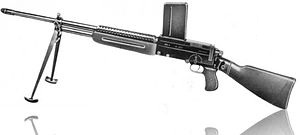
The Mendoza RM2 was a light machine gun similar to the M1918 BAR manufactured in Mexico by Productos Mendoza, S.A. It was chambered in .30-06 Springfield and had a 20 round magazine fed from the top.
Rafael Mendoza have been producing machine guns for the Mexican Army since 1933 and all have been noted for their lightness and cheap construction without sacrificing reliability. They use a gas cylinder system that delivers a short impulse to the piston, and the bolt is similar to that of the Lewis Gun, rotating and driven by two cams engaged with the piston rod. The RM2 is the most recent model and adds a simplified method of stripping, by simply removing a lock pin, the stock and rear of the receiver can be folded down to allow the bolt and piston to be withdrawn backwards.

Madsen

Saturday, 2 February 2013

Madsen machine gun

 Madsen
  Madsen
  Madsen
  Madsen
  Madsen
  Madsen
  Madsen
  Madsen
  Madsen
  Madsen
  Madsen
  Madsen
 Madsen


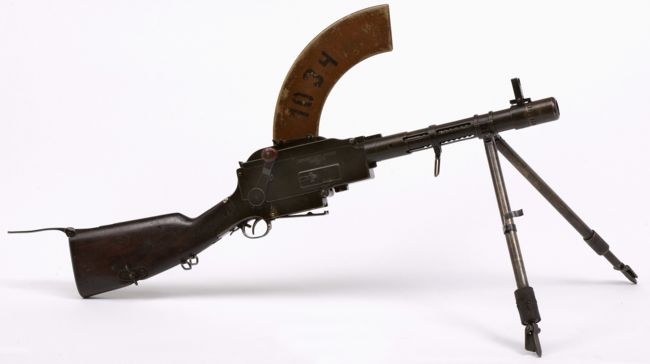
The Madsen was a light machine gun developed by Julius A. Rasmussen and Theodor Schoubue and proposed for adoption by Captain Vilhelm Herman Oluf Madsen, the Danish Minister of War and adopted by the Danish Army in 1902. It was one of the first true light machine guns produced in quantity and sold to over 34 different countries worldwide in 12 different calibres, seeing extensive combat use in various conflicts around the globe for over 100 years.
 The Madsen was produced by Compagnie Madsen A/S (later operating as Dansk Rekyl Riffel Syndikat A/S and then Dansk Industri Syndikat A/S).
Design details
The Madsen has a rather sophisticated and uncommon operating cycle not used in any other crew-served weapon. The machine gun uses a mixed recoil-operated locking system with a hinged bolt that is patterned after the lever-action Peabody Martini breechblock. The recoil operation is part short and part long recoil. After firing a round, the initial recoil impulse drives the barrel, barrel extension, and bolt to the rear. A pin on the right side of the bolt moves backward in grooves in an operating cam plate mounted to the right side of the receiver. After 12.7 mm (0.5 in) of travel, the bolt is cammed upward, away from the breech (the "short" portion of the recoil system). The barrel and barrel extension continue to move rearward to a point slightly exceeding the combined overall length of the cartridge case and projectile (the long portion of the recoil system, responsible for the weapon's low rate of fire).
After the breech is exposed, an odd lever-type extractor/ejector, mounted under the barrel, is pivoted to the rear, extracting the empty case and ejecting it through the bottom of the receiver. The bolt's operating cam then forces the bolt face to pivot downward, aligning a cartridge feed groove in the left side of the bolt with the chamber. While the bolt and barrel are returning forward, a cartridge-rammer lever, mounted on the barrel extension, is pivoted forward, loading a fresh cartridge