Breda 30

Friday, 4 January 2013

Breda 30

 Breda 30
  Breda 30
  Breda 30
  Breda 30
  Breda 30
    Breda 30 Ammo
    Breda 30 Ammo
    Breda 30 Ammo
    Breda 30 Ammo
  Breda 30
  Breda 30
 Breda 30

The Fucile Mitragliatore Breda modello 30 was the standard light machine gun of the Royal Italian Army during World War II.
The Breda M30 or Breda 30, was rather unique for a light machine gun. It was fed from a fixed magazine attached to the right side of the weapon and was loaded using brass or steel 20 round stripper clips. If the magazine or its hinge/latch were damaged the weapon became unusable. It also fired from a closed bolt along with using blowback for its action. Blowback operation could be violent, with poor primary extraction. During primary extraction, the initial very small rearward movement of the hot expanded cartridge case away from the chamber's walls must be powerful but very slow, if an automatic weapon is to be reliable. Separated cases, jamming the gun beyond field clearing, are the usual consequence of poor primary extraction. As an automatic weapon's chamber and barrel heat up with prolonged automatic fire, the resulting excessive temperature can cause a chambered round to cook off or ignite without intent of the gunner. As a result of firing from a closed bolt, the Breda 30 could not fully take advantage of the cooling properties of air circulation like an open bolt weapon could, thus making cooked off rounds a realistic hazard. The disastrous results could lead to potential injuries to or even the death of the gunner. The Breda 30 also inherently lacked good primary extraction in its design and thus utilized a small lubrication device that oiled each cartridge as it entered the chamber. With the dust and sand of the deserts of North Africa, came a combination of premature wear and jamming.
Some Bredas were re-designated as the M37 after being modified to accept the new 7.35 mm cartridge, which the Italian Military was making an effort to adopt; however, this was short-lived as slowed production never fully allowed adoption of the new cartridge. The Breda 30 was also mounted on a number of Italian armored fighting vehicles.
In regular Army units, one Breda 30 was issued each two squads, although this was later changed to one weapon per squad; an Italian infantry company would therefore have four to eight light machine guns in the first part of the war, but up to twelve in the latter part. Due to the importance of its extra firepower, the Breda 30 was most often given to the squad's most reliable soldier (unlike other armies of the time, it was not rare to see an NCO brandishing himself the squad's automatic weapon). The gunner normally had an assistant who would carry extra ammunition.

Besal

Thursday, 3 January 2013

Besal
 
 Besal
 Besal
 Besal
 Besal
Besal
 
The Besal, properly named "Gun, Light, Machine, Faulkner, .303-inch" was a light machine gun of British origin. The weapon was intended as a alternative for the Bren gun as it was lighter, simpler, cheaper, and easier to manufacture and therefore was not dependent of the Royal Small Arms Factory, Enfield which was within range of German bombers. As the threat to the supply Brens receded it was eventually deemed unnecessary

Colt Police Positive Special

Friday, 9 March 2012

Colt Police Positive Special
 Colt Police Positive Special
 Colt Police Positive Special
 Colt Police Positive Special
 Colt Police Positive Special
Colt Police Positive Special

Where to start? The Chicken or the Egg- the Revolver or the Cartridge? Both the Old Colt revolver and the .32 S&W Long cartridge have played important roles in handgun history but are largely ignored by the popular press.  Nevertheless, they have a cadre of dedicated enthusiasts and become the subjects of frequent discussion on the Internet boards.

Colt Peacemaker

Wednesday, 8 February 2012


The Colt Peacemaker was a single-action, six-round revolver and has excellent aim. It was preferred by law enforcers because of its firepower and reliability. The revolver had a .45 calibre and could load up to 2.6 grams of black powder and a 16.5 gram conical shaped bullet. When the gun was optimally loaded, the firepower it delivered was quite powerful.
 Colt Peacemaker
  Colt Peacemaker
  Colt Peacemaker
  Colt Peacemaker
  Colt Peacemaker
  Colt Peacemaker
  Colt Peacemaker
  Colt Peacemaker
  Colt Peacemaker
  Colt Peacemaker
  Colt Peacemaker
 Colt Peacemaker


Colt Peacemaker

Colt Paterson

Tuesday, 7 February 2012

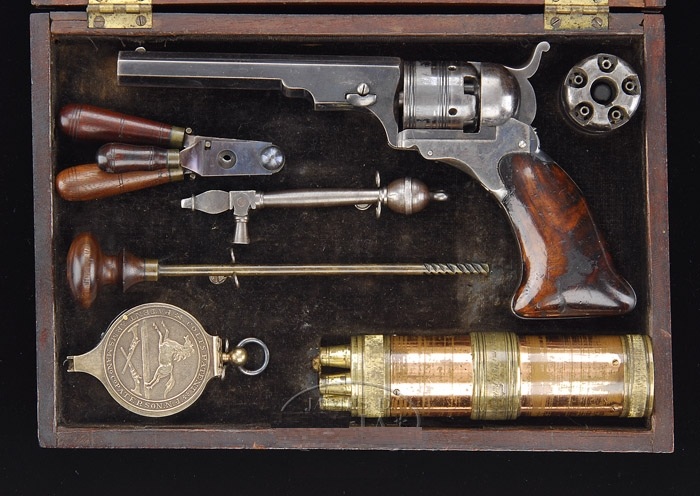
The comprehensive technical history of the rarest of all Colt firearms: the Paterson, made in the pioneer industrial city of the same name, in New Jersey, c. 1836 to 1842. The Paterson Colt Book presents text and illustrations based on over forty years of research and study, and is a joint effort of collector Dennis LeVett and the author. The photographs feature important examples of all models, as represented in the LeVett Collection, as well as from other collectors, museums and historical societies, augmented by data from the files of the late James E. Serven, and with technical notes from collector Robert Pershing, based on his own extensive research.
 Colt Paterson
  Colt Paterson
  Colt Paterson
  Colt Paterson
  Colt Paterson
  Colt Paterson
  Colt Paterson
  Colt Paterson

 Colt Paterson


Colt Paterson

Colt Official Police

Friday, 3 February 2012


The Official Police was a rugged, no-frills revolver designed for hard duty.
Unless you are a complete newbie to firearms, or have been living on top of a mountain in Tibet for the last century, you are aware that from the 1870s until the middle of the 20th century the terms “Colt” and “revolver” were synonymous in the police world. Colt revolvers were the most popular law enforcement sidearms in the world, and no Colt product personified the law enforcement handgun better than the Official Police Revolver.


Colt Official Police